THE LEGACY OF THE BLADE
The origins of fencing can be traced back to the transition of swordsmanship from a tool of war to a refined art of self-defense. This evolution began in the late middle ages, where guilds in Europe started codifying techniques for the judicial duel and civilian security.
By the Renaissance, the fencing masters of Italy and Spain introduced the rapier, shifting the focus towards precision thrusts over heavy cuts. This period marked the birth of modern fencing theory, emphasizing agility, distance, and the intellectual mastery of the blade.
Today, fencing survives as a highly strategic Olympic sport. It combines the historical weight of its martial roots with cutting-edge athletic performance, continuing to challenge the mind and body of practitioners across the globe.

Key Figures & Eras

The Italian Renaissance
Domenico Angelo and other masters transformed fencing from a brutal survival skill into a sophisticated art form, emphasizing speed and intellectual strategy over raw power.

The French School
The 18th and 19th centuries saw the emergence of the foil and the development of modern conventions, prioritizing precision and the 'phrase d'armes'.

The Olympic Era
Pierre de Coubertin, a fencer himself, ensured its inclusion in the first modern Olympics in 1896, marking the sport's transition to a global competitive discipline.

Origins: From the Battlefield to the Salle
An overview of the transition from military combat to the structured rules of modern competition.
-
The Renaissance Shift: Originally, the sword was a tool of war. As heavy plate armor disappeared with the advent of firearms, the heavy broadsword gave way to the Rapier. Fencing shifted from "hacking" to "thrusting," prioritizing speed and precision over brute force.
-
The School of Honor: In the 17th and 18th centuries, fencing became an essential part of a gentleman’s education. Master fencing instructors (Maîtres d'Armes) in France and Italy established the first Salles d'Armes, turning a survival skill into a refined "Science of Defense."
-
The Invention of the Mask: A pivotal moment occurred in the 1780s when the fencing mask was invented by La Boëssière. This allowed for much faster, more aggressive practice without the constant fear of losing an eye, leading to the complex "phrase d'armes" (the conversation of the blades) we see today.
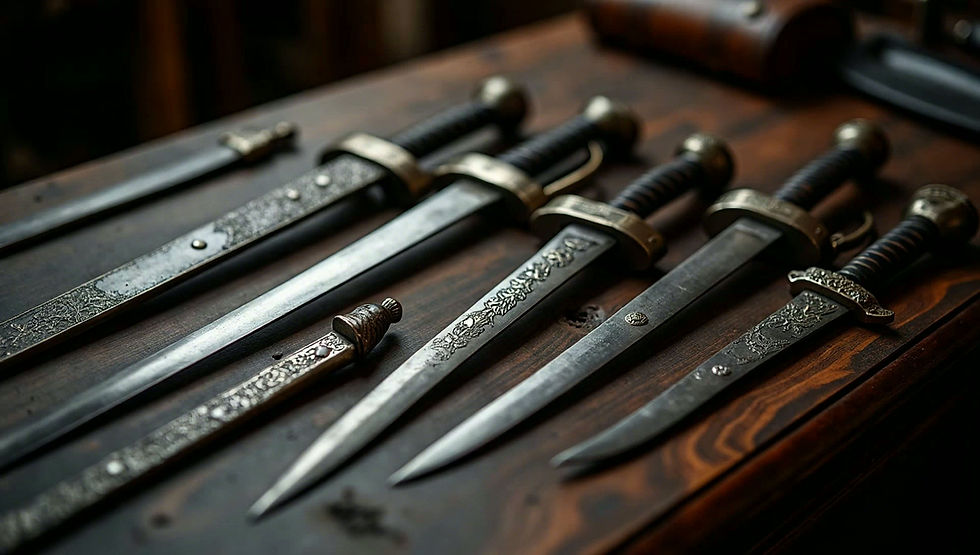
The Forge of Progress: Metallurgy and Design
How scientific advancements in steel production and electronics changed the way fencers move and strike on the strip.
-
From Visual to Digital: For decades, "four judges and a director" watched for hits using only their eyes. The introduction of Electrical Scoring (Épée in 1936; Foil in 1956; Sabre in 1988) revolutionized the sport, removing human bias and rewarding microscopic touches that the human eye could never catch.
-
Maraging Steel: After the tragic death of Vladimir Smirnov in 1982, the industry shifted to Maraging Steel. These blades are not only lighter and more flexible but are designed to break "flat" rather than into jagged shards, dramatically increasing athlete safety.
-
The Lightweight Revolution: Modern fencing kits have evolved from heavy canvas to 800N ballistic-grade fabrics (like Kevlar and Dyneema). This reduction in weight allowed fencers to transition from static lunges to the explosive, athletic "bouncing" footwork seen in the modern era.
The Living History of the Blade
Explore our curated collection of historical footage and expert commentary, documenting the evolution of fencing from noble duel to Olympic discipline.
VIDEO ARCHIVE

The Olympic Era Emerges
Witness the first international championships where standardized rules were established for the three weapons.
-
The Baron’s Vision: Pierre de Coubertin, the founder of the modern Olympics and a fencer himself, included the sport in the inaugural 1896 Athens Games. It is one of the few sports to have been featured in every single modern Olympiad.
-
Defining the Three Weapons: This era codified the unique identities of the weapons:
-
Foil (Fleuret): Developed as a training tool for the duel with strict "Right of Way" rules.
-
Épée: The direct descendant of the professional duel, where the entire body is a target, mimicking a "first blood" encounter.
-
Sabre: Derived from the cavalry sword, emphasizing the cutting edge and the speed of the horseman.
-
-
The Birth of the FIE: The 1913 founding of the Fédération Internationale d'Escrime (FIE) in Paris brought an end to centuries of regional disputes over rules, creating a truly global competitive language.

Modern Strategy & Technique
Connecting historical principles to the high-speed tactical decisions made in current international fencing.
-
Physicality Meets Chess: While the 19th-century fencer relied on poise, the 21st-century fencer is a high-performance athlete. The sport has become a "physical game of chess" played at 200 kilometers per hour, requiring elite aerobic conditioning and split-second reaction times.
-
Global Styles: Explore how different "national schools" have merged. The traditional French finesse and Italian athleticism have been influenced by the Russian/Eastern European analytical approach and the rising dominance of Asian fencing, which emphasizes incredible foot speed and distance control.
-
Video Review & Data: Today’s matches are often decided by "Video Appeals," where coaches and athletes analyze high-speed replays in real-time. History is no longer just in books; it is recorded in frame-by-frame data, pushing the tactical boundaries of what is possible on the strip.